


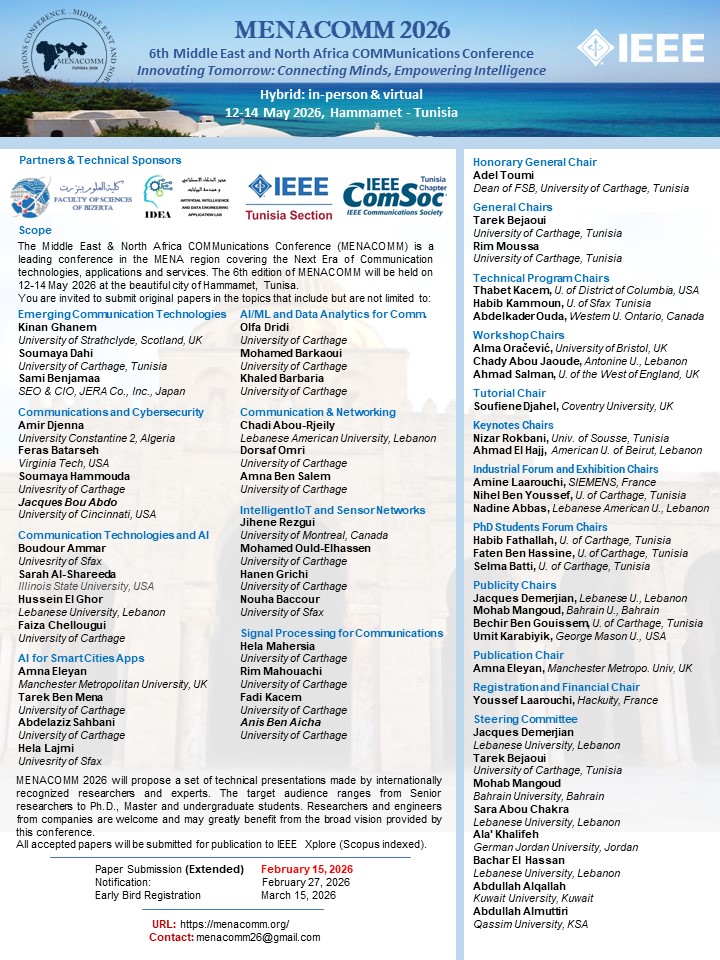
6th Middle East & North Africa COMMunications Conference: Innovating Tomorrow: Connecting Minds, Empowering Intelligence...
Keynote Speakers
Keynote Speakers

Khaled B. Letaief
TRANSFORMING CONNECTIVITY: AI INNOVATIONS FOR NEXT-GEN WIRELESS NETWORKS
Abstract
As we embark on the 6G revolution, wireless networks are evolving from mere communication tools into dynamic, intelligent ecosystems that will reshape our digital landscape. Beyond providing astonishing data speeds, 6G introduces groundbreaking advancements in ultra-reliable low-latency connections, massive device integration, and real-time intelligence right at the network edge. This talk explores how artificial intelligence—particularly foundation models with generative, multimodal, and autonomous capabilities—is revolutionizing connectivity. These adaptable AI systems empower wireless networks to anticipate channel dynamics, optimize itself with pinpoint accuracy, enhance security, and make autonomous decisions in rapidly changing environments. By facilitating intelligent communication and self-optimizing behaviors, these powerful models elevate wireless infrastructures from mere reactive systems to proactive, learning, and agentic entities. Fueled by global research collaborations and real-world testbeds, foundation models are poised to be the heart of AI-native 6G design. In this talk, we will showcase how AI-driven networks are set to transform future connectivity and how foundation models are enabling the next generation of wireless systems to think, adapt, and act with human-like intelligence—paving the way for hyper-realistic virtual worlds, autonomous cities, and seamlessly interconnected industries.
Biography
Dr. Letaief is an internationally recognized leader in wireless communications and networks with research interest in 6G, AI, task-oriented and semantic communications, along with integrated sensing and communications. He is a Member of the United States National Academy of Engineering, Fellow of IEEE, and Member of the Hong Kong Academy of Engineering. He is also recognized as Clarivate Highly Cited Researcher with over 65,000 citations and an exceptional 112 h-index. He was also named one of the top 30 Most Influential Scholars in AI and the Internet of Things. He is the founding Editor-in-Chief of the prestigious IEEE Transactions on Wireless Communications. He is the recipient of many distinguished awards and honors including the 2024 Purdue University Distinguished Engineering Alumni Award; 2024 IEEE James Evans Avant Garde Award; 2022 IEEE Edwin Howard Armstrong Achievement Award; 2019 IEEE Communications Society and Information Theory Society Joint Paper Award; and 2016 IEEE Marconi Prize Award in Wireless Communications. He is well recognized for his dedicated service to professional societies and in particular IEEE where he has served in many leadership positions. These include IEEE Communications Society President, the world's leading organization for communications professionals with headquarter in New York City and members in 162 countries, as well as member of the IEEE Board of Directors. Since 1993, he has been with HKUST in Hong Kong where he has held various leadership roles, including Acting Provost and Dean of Engineering. Dr. Letaief received the BS degree with distinction, MS and Ph.D. Degrees in Electrical Engineering from Purdue University at West Lafayette, Indiana, USA. He also received a Ph.D. Honoris Causa from the University of Johannesburg, South Africa.
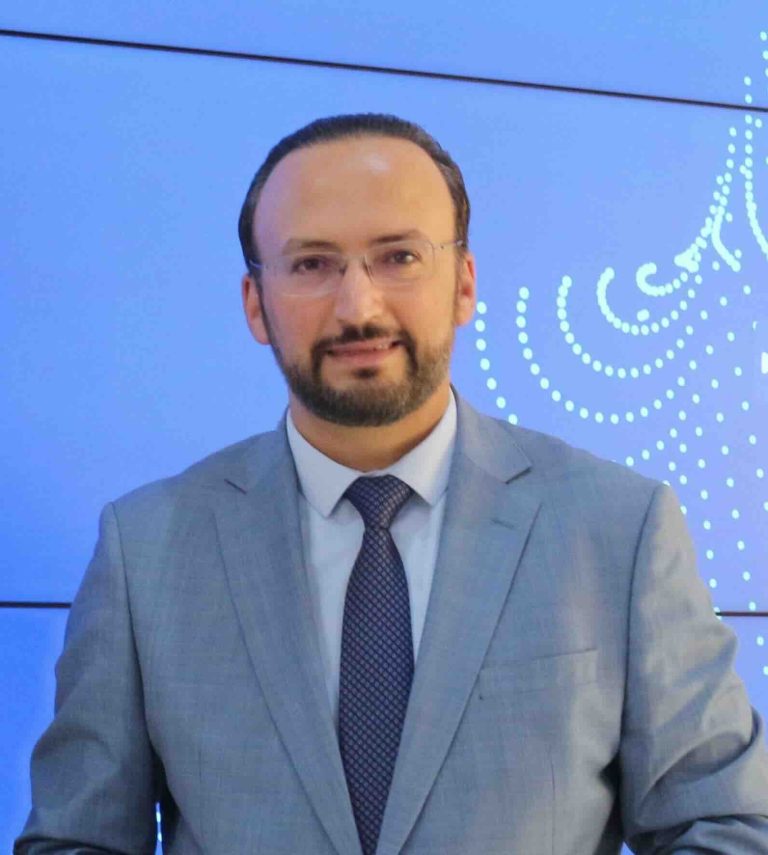
Nizar Ben Neji
Talk title: TBA
Abstract
TBA
Biography
About 20 years of experience as IT expert and strategist. Dr. Nizar Ben Neji was in charge of the Ministry of Communication Technologies in Tunisia from the 2nd of August 2021 to the 25th August 2024 and during the three-years period, he was responsible of setting in place and implementing the national digital strategy 2025 of Tunisia. Dr. Ben Neji was previously lecturer and researcher at the University of Carthage in Tunisia and former Fulbright visiting scholar at the Massachusetts University of Amherst in USA. Nizar Ben Neji started his professional career as engineer then project manager at the Tunisian Government Certification Authority (TunTrust) from 2005 to 2013 and was member of several National Steering committees and working groups in charge of supervising and conducting National IT and e-Government projects in Tunisia. Since 2013, Dr. Nizar Ben Neji was actively involved as ICT expert at an international level with CTO (Commonwealth Telecommunications Organization), ITU (International Telecommunication Union) and AICTO (Arab Information and Communication Technology Organization), in delivering seminars and projects in wide variety of subjects related to cybersecurity and cybercriminality. Dr. Ben Neji has delivered several successful projects at an international level in France, South Africa, Nigeria, Cameroon, Tchad, Burundi, Ivory Coast, Mali, Union of the Comoros, Mozambique, Indonesia, Trinidad and Tobago and Tunisia.
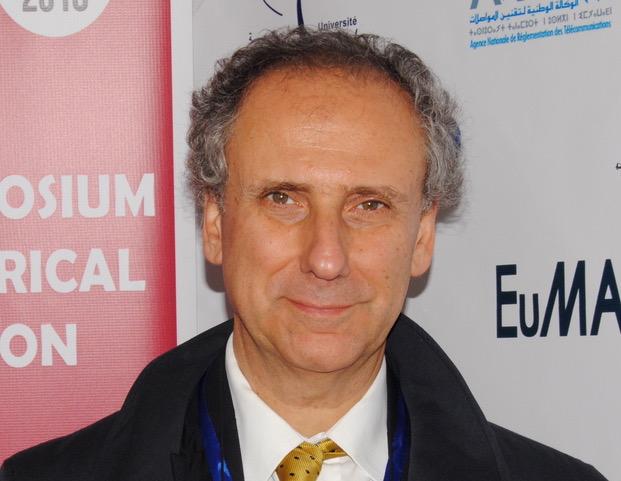
Michele Luglio
Innovations in satellite networks for advanced architectures and services
Abstract
To satisfy even more demanding requirements of services and users, complexity of architectures and of technological components must increase as well. Satellite systems, already intrinsically more complex than terrestrial ones, must face also the issue of integration with the other components, not only at technical level but also to convince manufacturers and operators, usually reluctant to pursue this objective. Compliance with 5G/6G standard represents an important step, necessary but not sufficient, to reach this goal. The set up of megaconstellations, with the capability to offer meaningful technical performance and cost/effectiveness, is a further step towards this integration, although the operators preferred to implement proprietary standards. The introduction of the use of satellites in the latest releases of the 3GPP standards, although with some limitations and constraints, and some support from research programs can help the process but more work must be carried out with the aim to fully satisfy user and service requirements (real and hopeful starting point of ant system). The keynote speech will approach the above issues also in the light of some innovative solutions.
Biography
LUGLIO MICHELE received the Laurea degree in Electronic Engineering at University of Rome “Tor Vergata” in 1990 and the Ph.D. degree in telecommunications in 1994. In 1992 he worked, as visiting Staff Engineering at Comsat Laboratories (USA). From 1995 to 2004 he was research and teaching assistant at University of Rome “Tor Vergata”, where till now he is associate professor of telecommunications. In 2001 and 2002 he was visiting Professor at the Computer Science department of University of California Los Angeles (UCLA) to teach Satellite Networks class. He teaches “Internet via Satellite” and “Fundamentals of Telecommunications”. He works on designing innovative satellite communications systems for multimedia services, both mobile and fixed. His research is focused on network protocols, resource management, heterogeneous networks and on 5G development with particular regard to satellite systems. He was general chair, general co-chair, technical program chair, keynote speaker at several international conferences He is member of the editorial board of China Communications and of IAENG Engineering letters. From 2018 to 2021 he was affiliated also to the Italian Space Agency and the Italian expert delegate and co-chair of the advisory committee 5JAC of ESA. He is author of more than 200 international publications. He was president of NITEL consortium and is co-founder and president of Romars company.
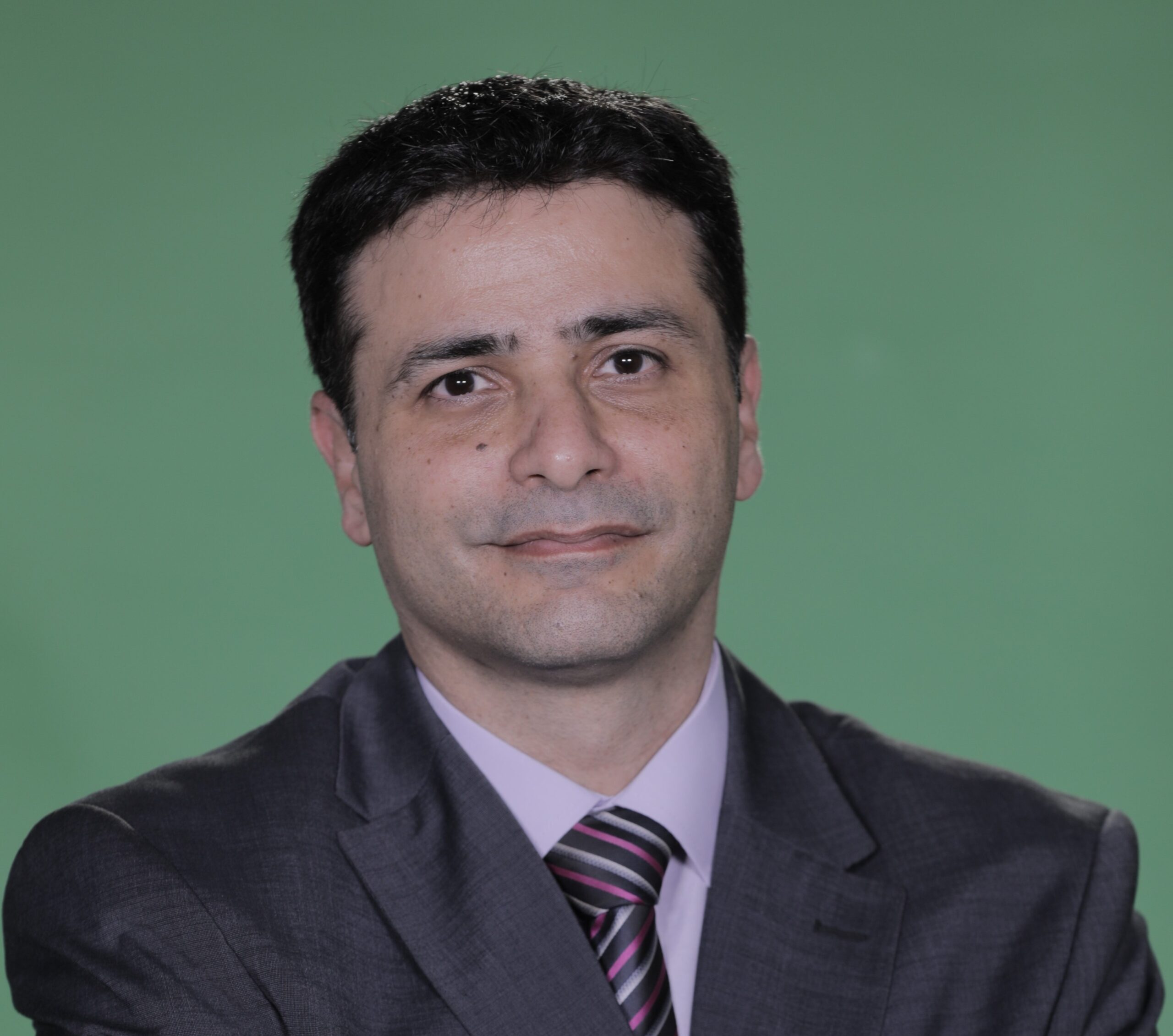
Imad Elhajj
AI For or Against Privacy?
Abstract
AI clearly has the potential to advance research in different domains include privacy preservation. However, equally AI can serve the adversarial. With this dual use in mind we will explore our work in the field of AI for and against privacy. We will present several techniques targeting preservation of visual privacy, particularly from video feeds being generated on a mobile device. We will highlight the challenges of real-time privacy preservation and the challenge of embodied AI. In addition, we will discuss our work in adversarial AI ranging from detection algorithms to LLMs.
Biography
Imad H. Elhajj is a Professor with the Department of Electrical and Computer Engineering and is the Associate Dean for Academic Transformation at the Maroun Semaan Faculty of Engineering and Architecture at the American University of Beirut. In 2014, he co-founded SAUGO 360, the first startup to be incubated at AUB, and in 2017 he co-founded the Humanitarian Engineering Initiative at AUB. Dr. Elhajj is the past chair of IEEE Lebanon Section. He has served as an ABET program evaluator since 2013. His research interests are at the intersection of robotics, networking, and human machine interfacing with applications in health and environment. Dr. Elhajj is recipient of the IEEE Outstanding Branch Counselor and Advisor Award (2019), the Teaching Excellence Award at the American University of Beirut (2011), the Kamal Salibi Academic Freedom Award (2014), and the most Outstanding Graduate Student Award from the Department of Electrical and Computer Engineering at Michigan State University (2001).
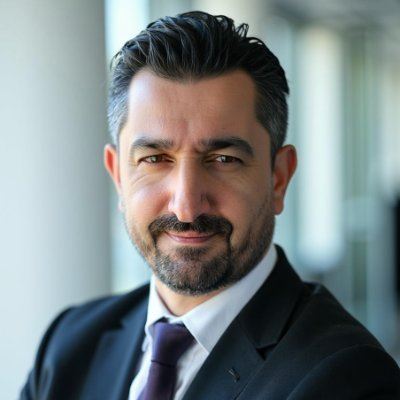
Suat Özdemir
Digital Twin-Driven Task Offloading for Next-Generation IoT Networks
Abstract
As the Internet of Things (IoT) scales into complex, heterogeneous environments, traditional paradigms of static processing and centralized control fall short. The future of IoT demands networks that are intelligent, responsive, and capable of dynamic resource management. At the heart of this transformation lies the convergence of digital twins and task offloading, enabling a new generation of adaptive, efficient, and resilient IoT infrastructures. This keynote will present cutting-edge developments in digital twin-based modeling and its integration with task offloading strategies, particularly in fog and edge computing environments. The talk will also highlight our recent research on deep reinforcement learning frameworks for microservice offloading and digital twin-supported vehicular edge computing. Moreover, we will explain how digital twins provide real-time, virtualized representations that enhance contextual awareness and decision-making for IoT tasks. Finally, scalable task offloading architectures and case studies demonstrating the operational impact of these technologies in smart city, transportation, and mission-critical applications will be evaluated as well.
Biography
Suat Özdemir has been a faculty member in the Department of Computer Engineering at Hacettepe University in Ankara, Turkey since May 2020. He is the head of Artificial Intelligence Engineering division of the department. Prior to this, he served at Gazi University’s Computer Engineering Department from 2007 to 2020. He holds an MSc in Computer Science from Syracuse University (2001) and a PhD in Computer Science from Arizona State University (2006). With a professional career that bridges academia and industry, Prof. Özdemir has maintained strong collaborations with the industrial sector for over a decade. From 2010 to 2014, he contributed as a senior researcher at TÜBİTAK, Turkey’s leading research institution, working on nationally significant projects. He is an active member of the IEEE and contributes to the global research community by serving as an editor, technical program committee member, and reviewer for numerous high-impact IEEE and ACM journals and conferences. His work spans areas of computer engineering with a particular emphasis on network security, IoT, and emerging computing paradigms.
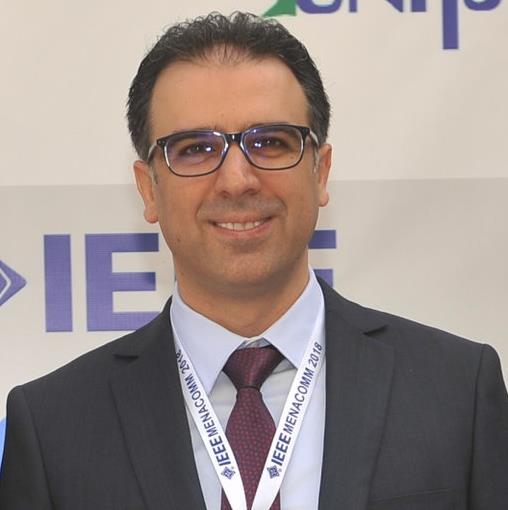
Abdallah Makhoul
Toward Intelligent Programmable Matter: Distributed Self-Reconfiguration and Embedded AI
Abstract
Programmable Matter (PM) envisions materials made of autonomous micro-modules capable of changing shape and function in response to their environment. This talk explores the convergence of modular robotics and artificial intelligence to realize smart and autonomous programmable matter. We will explore the new self-reconfiguration algorithms developed for 3D Catoms, quasi-spherical robots forming dynamic 3D structures, and a distributed MaxFlow-based approach for coordinated movement within porous environments. We will then discuss how embedding artificial neural networks within modular systems enables local computation and distributed adaptive behavior. Together, these advances point toward the emergence of AI-driven self-reconfigurable matter for future applications in robotics, materials science, and smart environments.
Biography
Abdallah Makhoul is a full professor in Computer Science at University Marie et Louis Pasteur, France. He received the PhD degree in computer science from the University of Franche-Comté (UFC), France, in 2008. He is member of the DISC department (department of computer science and complex systems) of FEMTO-ST institute, where he leads the research team OMNI (Optimization, Mobility and NetworkIng). His current research interests include distributed algorithms, Internet of Things, programmable matter, and AI for industrie 4.0. Prof. Makhoul has supervised 17 doctoral students, demonstrating a strong commitment to graduate education and mentorship. Prof. Makhoul has published over than 160 papers in refereed journals and Conferences. He has been a TPC chair and member of several networking conferences and workshops and guest editor and Reviewer for several international journals. He has coordinated and participated in several national and international research projects.

Contact
Email:
menacomm26@gmail.com
Partners


Important Dates
Submission Deadline (Extended):
February 15, 2026 (FIRM)
Acceptance Notification:
March 15, 2026
Early Bird Registration:
March 29, 2026
Regular Registration:
April 12, 2026
Call for papers
© Copyright 2025 IEEE – All rights reserved. Use of this website signifies your agreement to the
IEEE
Terms and Conditions.
A not-for-profit organization, IEEE is the world's largest technical professional organization dedicated
to advancing technology for the benefit of humanity.
THIS WEBSITE IS HOSTED BY OSITCOM
